Safety in the CRE Community
Preventing Seller Impersonation Fraud in CRE Transactions
As our world grows more connected, and scams grow more sophisticated alongside it, NC REALTORS® has put out a helpful checklist for preventing seller impersonation fraud in commercial real estate transactions.
Their guidance boils down to one rule: if you're listing commercial property for someone you've never met in person, treat it as a potential scam until proven otherwise.
Verification steps:
- Require a Government-Issued Photo ID: Ensure the name and address match public records for the record property owner. Be cautious of IDs that are blurry, cropped, or barely legible.
- Require a Live, Face-to-Face, Video Chat with the Seller: Do not click any links sent by the seller for a video chat. Send your own link to make the connection, because some scammers use fake Zoom links to infect your computer. Once connected, make sure the person in the video chat matches the ID, but beware that some sophisticated scammers may be able to use AI to make their face match an ID, even if the ID is real (but stolen). Other scammers may just use a fraudulent ID that has their face on it with the real owner’s information. A seller’s refusal to speak live, on video, and using your Zoom link is a major red flag.
- Visit the Property in Person and Confirm the Seller Knows Details: Visit the seller’s property in person, and then ask the seller about details of the property to see if they know them. For example, if you ask the seller what they would like to do about an old shed on the property, but there is no shed because you made up that fact to test them, then a seller who assumes the shed is there is very likely a scammer. If the seller is instead confused or corrects you that there is no shed, then you know they may not be a scammer. Feel free to ask about large rocks, streams, or other land features instead to test the seller’s knowledge. If the seller is asking you to list property far away, that is also a major red flag because they likely do not want you to be able to easily visit the property.
- Cross-Check the Seller’s Identity Using Tools Like Forewarn: Forewarn can help identify whether the seller has any known association with the property, and whether the email address, phone number, and other contact information is consistent with the contact information of the legitimate owner.
- Independently Locate and Contact the Owner and Talk to Neighbors: Even if a Forewarn check comes back with no flags, and even if the seller has talked to you on a live video chat, use the information on the deed and tax records to contact the record owner, and be sure to contact neighbors. Do a Google and a social media search of the seller’s name, and see if the contact information you have been given matches the contact information from your independent searches. If the information does not match, you are likely speaking with a scammer and not the owner.
- Ask for Ownership Documents Only the True Owner Would Have: Ask for closing disclosures or settlement statements; utility bills; a copy of a property tax bill (preferably one recently paid, showing ownership and billing address); title insurance policies; original property surveys; prior listing agreements; and other documents only the seller would have.
- Be Wary of “Quick Cash Sale” Requests and Below-Market Prices: Many fake sellers push for an all-cash deal, a reduced price, and a fast closing to avoid scrutiny.
- Research Recent Sales and Withdrawals of the Same Property: If the parcel was recently listed, withdrawn, or sold, speak to the prior listing broker to see if a fraud attempt was previously made.
- Educate and Protect All Parties: Communicate clearly with buyers, closing attorneys, and your BIC about any concerns. Where appropriate, alert authorities such as the North Carolina Attorney General or FBI Internet Crime Complaint Center if fraud is suspected. Keeping notes, copies of correspondence, and screenshots of ID verification or property records may protect you if a dispute later arises.
- Coordinate Early with the Closing Attorney: As soon as a contract is signed, notify the closing attorney of any red flags or concerns. Title professionals may uncover issues through identity verification protocols, trust or estate complications, and prior title history.
- Other Red Flags to Watch For:
-Seller claims they are traveling abroad or in a family emergency.
-Pressure to close quickly and accept a lower-than-market offer.
-Seller offers a bonus or incentive to ensure the transaction closes.
-Communication is limited to email or text, with evasiveness around calls or video.
-Seller wants a quick Due Diligence Fee or is unwilling to accept Earnest Money.
-Seller’s email address or phone number is from another country.
The fake seller scam is becoming more sophisticated and increasingly targets both residential and commercial transactions. Never rely solely on documents or information the “seller” or a lead service provides. If red flags persist and identity cannot be confirmed, do not proceed with the listing and escalate the issue to your Broker-In-Charge. Brokers are strongly encouraged to discuss these best practices at office meetings and include fraud prevention as part of onboarding and ongoing agent training programs.
Release Date: 07/31/2025; Updated 4/20/2026
© Copyright 2025 - 2026. North Carolina Association of REALTORS®, Inc.
This article is intended solely for the benefit of NC REALTORS® members, who may reproduce and distribute it to other NC REALTORS® members and their clients, provided it is reproduced in its entirety without any change to its format or content, including disclaimer and copyright notice, and provided that any such reproduction is not intended for monetary gain. Any unauthorized reproduction, use or distribution is prohibited.
Your Break Could Be a Hacker's Opportunity
Heading out for summer vacation? Cybercriminals don't take time off—and they often target businesses when guards are down. Protect your commercial real estate business with these four essential security steps.
Summer Cybersecurity Tips for Commercial Real Estate Professionals
Update Everything
Install all software updates and security patches before you travel. Outdated systems are easy targets for hackers.
Use a VPN
Never send sensitive information over public Wi-Fi. Use a Virtual Private Network to encrypt your data on hotel, airport, and café networks.
Disable Auto-Connect
Turn off automatic Wi-Fi and Bluetooth connections. Manually choose trusted networks to avoid connecting to malicious hotspots.
Secure Your Devices
Keep work devices in sight and set them to auto-lock. Use strong passwords or biometric authentication to prevent unauthorized access.
Bottom Line
Commercial real estate operates year-round, but you can still enjoy your summer safely. A few minutes of security prep protects your business data and client trust while you're away.
Don't let vacation time become cyber-attack time.
NC REALTORS Tech Helpline
(877)573-5612
Safety Focus for Technology
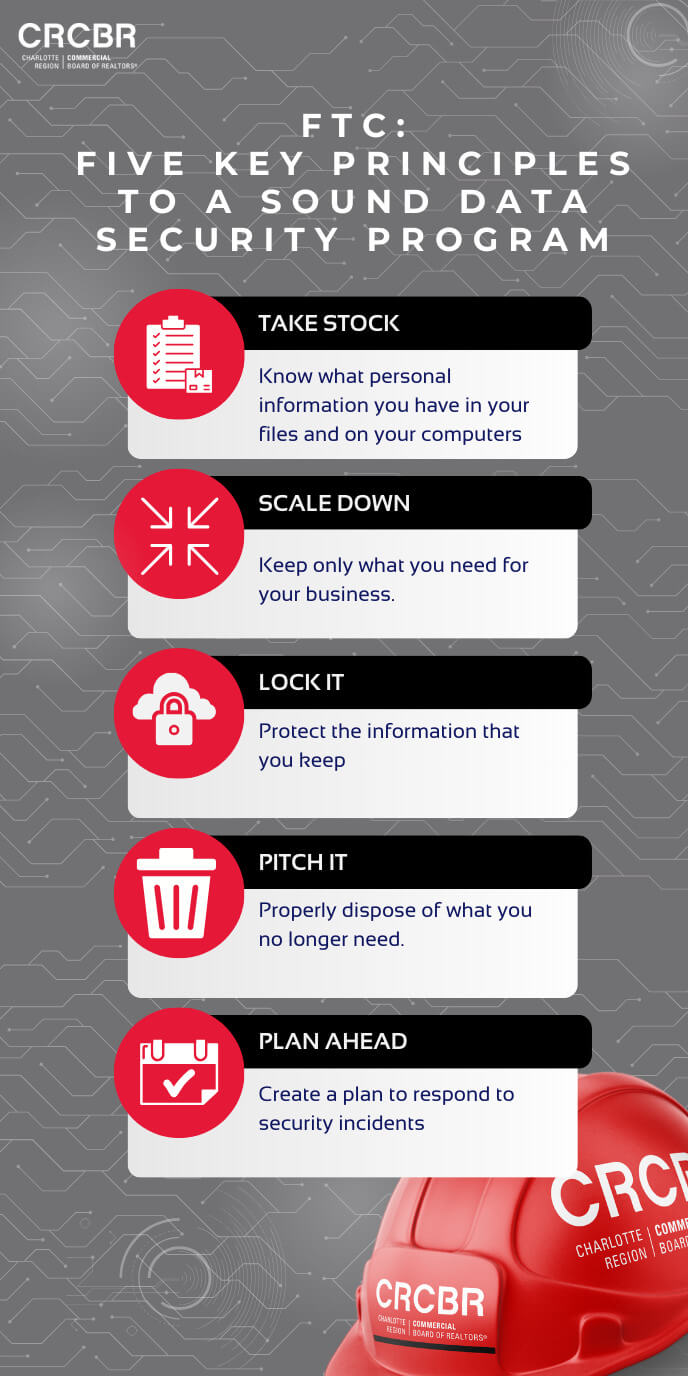
The real estate profession is constantly adapting to technological advancements. While these changes bring numerous benefits, they also introduce new risks. Modern tools like smartphones, tablets, apps, social media, and various software enhance client communication and property marketing. However, they simultaneously create vulnerabilities that criminals can exploit, targeting both real estate professionals and their clients.
In our digital age, where information and financial transactions occur instantly, there's an increased risk of interception by malicious actors. This can lead to significant harm for both you and your clients. To help mitigate these risks, we've compiled a set of guidelines below. These recommendations are designed to help you protect the sensitive data that you and your clients regularly exchange during your business.
CRCBR President, Kim Kendall, sat down with Captain Bret Balamucki of CMPD to discuss various issues (and solutions) that commercial brokers may face. Captain Balamucki offers tips and strategies to remain safe in your practice.
Highlights:
- Showing vacant properties
- Addressing unwanted visitors on property
- Prepping for a big prospect
- Engaging with CMPD Community Coordinators
- Meeting new clients
- Property owner for safety (Authority to Act)
- Cyber security and QR Codes
Important CMPD Resource Links
Addressing unwanted visitors on properties
Show Your Appreciation
Know Your Community Coordinators
Broker Safety
40% of real estate professionals stated they experienced a situation that made them fear for their personal safety.
The safety of our members is a top priority. Our members routinely find themselves in situations where they are alone with clients they have very little background information on. The very nature of showing real estate to prospective buyers and tenants who are virtual strangers can make both men and women susceptible to becoming victims of violent crimes. During these times, it is also important to consider your safety from a health perspective. CRCBR aims to provide members with practical information to keep safety top of your mind.